

12 Oct 2026
Sale & Lease Back Financing
What is Sale & Lease Back financing?
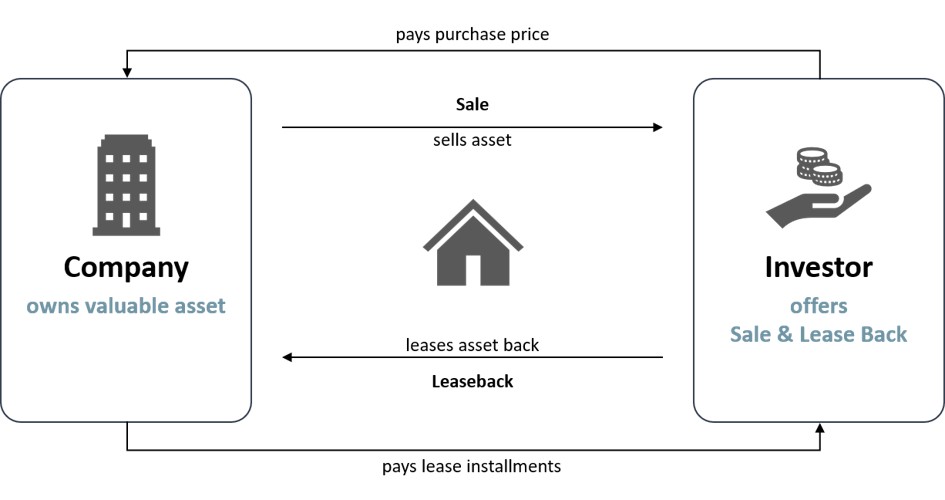
In a Sale & Lease Back (SLB), a company sells an asset to an investor and immediately leases it back on a long-term basis. In practice, these are usually business-critical properties such as plants, production facilities or warehouses, although other long-lived assets such as machinery and equipment can also be suitable. The sale proceeds flow to the company as liquidity and can be used, for example, to invest in the core business or to pay down debt. In return, the company pays regular rent and continues to use the property as before. The lease term, renewal and buyback options, and the allocation of maintenance, taxes and insurance are negotiated individually between the parties. An SLB is not an instrument reserved for special situations, but a standard component of the financing mix, alongside bank loans, Schuldschein loans and equity.
What are the advantages of Sale & Lease Back financing?
- Market value instead of lending limits: Banks only lend against part of a property’s value, leaving the company to fund the rest with equity. In an SLB, the purchase price is based on the full market value. An SLB replaces not only debt but also equity tied up in the property.
- Business as usual: The company continues to use the property; its location and operations remain unaffected.
- Predictability without refinancing risk: Instead of a loan with a fixed-rate period that eventually needs refinancing, the company has a long-term lease.
- Fewer restrictions: Financial covenants found in loan agreements are uncommon in leases. Like banks, however, investors usually require rent deposits or guarantees and regular financial reporting.
- Additional source of financing: An SLB complements bank financing and preserves existing credit lines.
Why is Sale & Lease Back particularly relevant right now?
Banks are becoming increasingly cautious: according to the Bundesbank’s Bank Lending Survey, banks tightened their credit standards for corporate loans again in the second quarter of 2026. Companies are feeling the impact: in the same period, 40.5% of SMEs in need of credit described their banks as restrictive, the highest share since the KfW-ifo survey began in 2017. Among large companies, the figure was 32.9%, the second-highest level on record. At the same time, investment needs are high: according to the BDI study “Transformation Paths”, Germany will require around €1.4 trillion in additional investment by 2030, roughly two-thirds of it from companies and private households.
On top of this, many SMEs are facing a generational handover: according to KfW, around 545,000 small and medium-sized companies are seeking a succession solution by the end of 2029, which amounts to just over 109,000 per year. Operational real estate often complicate the handover, for example when the operating business is to be transferred but the property is not.
Meanwhile, companies looking to sell are meeting a market that is picking up again: according to JLL, investment volume in German logistics and industrial real estate rose by 22% to €2.9 billion in the first half of 2026, significantly outpacing the overall market (+15%).
Why is operational real estate well suited to a Sale & Lease Back?
Operational real estate often hold considerably more value than the balance sheet suggests: they are carried at historical cost and depreciated on a scheduled basis, while their market value has often increased over the years. At the same time, owning the property ties up capital for decades. This capital is then unavailable for the core business, for example for machinery, automation or research and development. An SLB turns these hidden reserves into usable liquidity.
SLB investors also approach their investment decisions differently from banks. Whereas banks assess the company’s overall situation on the basis of a rating, investors focus primarily on the property (i.e., location, alternative-use potential and condition), the term of the SLB and the tenant’s ability to meet the lease payments. This creates additional financing headroom, independent of existing credit lines.
SLB structures once again dominated property sales by German companies in 2025, with the share accounted for by manufacturing companies rising from 25% (2015 to 2019) to 46%. Across Europe, too, the majority of SLB transactions involve industrial properties.
Which other assets are best suited to a Sale & Lease Back?

When is Sale & Lease Back financing an option for your company?
- To finance investments, transformation and expansion
- To finance an acquisition
- To repay or refinance existing loans
- As part of a business succession or a change of shareholders
- In preparation for a sale of the company
- When selling a business unit (carve-out)
- For general liquidity management
Have we sparked your interest, or do you have any questions? We advise on SLB transactions with volumes starting at ~€10 million, from the initial assessment through to closing. Together we will assess whether a Sale & Lease Back fits your financing strategy.
Your contacts