
Animal health M&A hasn’t just recovered, it’s been reshaped.
Private equity (PE) is both driving the rebound and changing who the winning buyers are. Based on our analysis of 1,850 global animal health transactions between 2021 and 2025, here’s the evidence, and what it means for you, whether you’re exploring a sale or simply watching the market.
The recovery is real, and PE built it
Global deal volume fell after 2022, then recovered to 406 deals in 2025, up 46% since 2021 and within 7% of the 2022 peak.
That recovery has one clear author. PE funds and PE-backed platforms made up 54% of all acquirers in 2025, the highest share and highest volume (around 220 deals) in five years. Take PE out of the picture, and the recovery barely happened.
Europe and North America drive 85% of this activity, so for most owners in the sector, this isn’t a distant trend. It’s happening in your market.
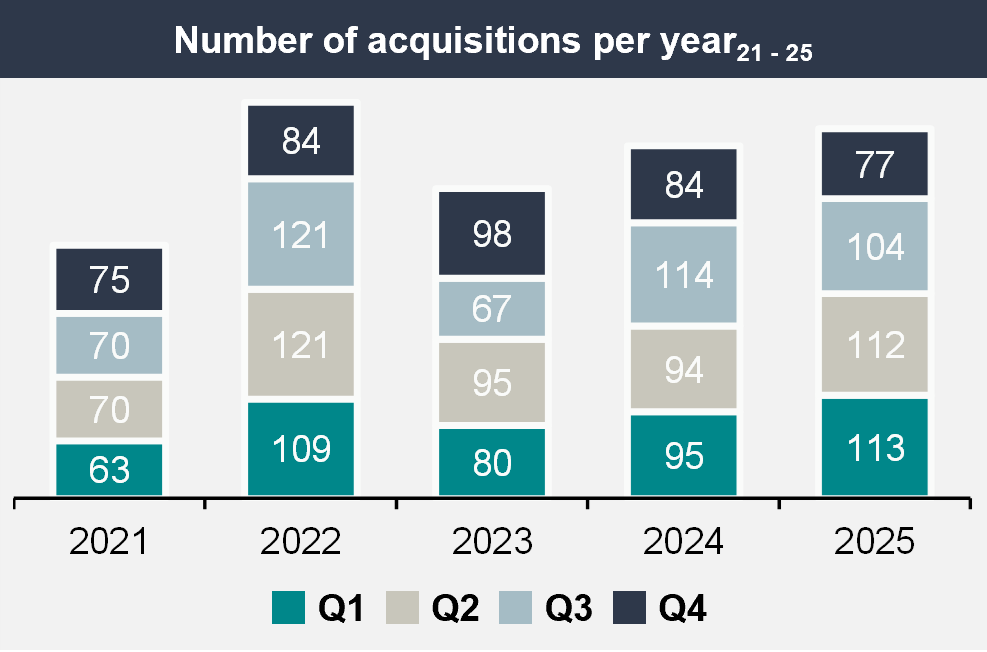
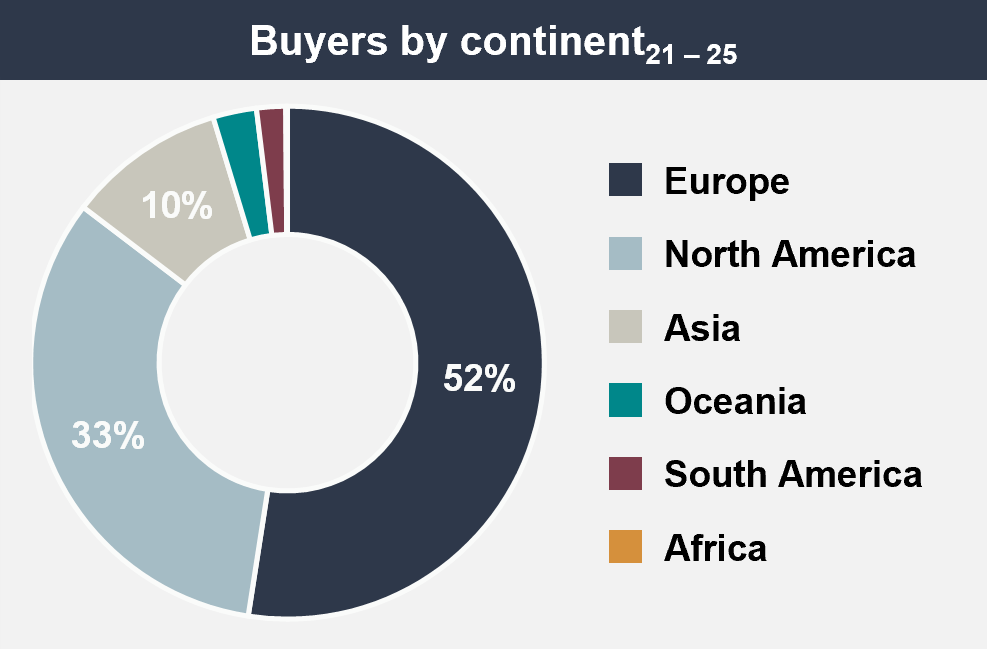
The buyer landscape has genuinely changed. Three buyer types now compete for deals in animal health:
- Strategic buyers – established companies acquiring others to grow directly, eg a feed additive manufacturer buying a competitor
- Financial buyers – PE funds buying companies directly for financial return
- Sponsor-backed buyers – companies owned by a PE fund, acquiring further businesses to build scale
Financial and sponsor-backed buyers together make up what we call private equity involvement.
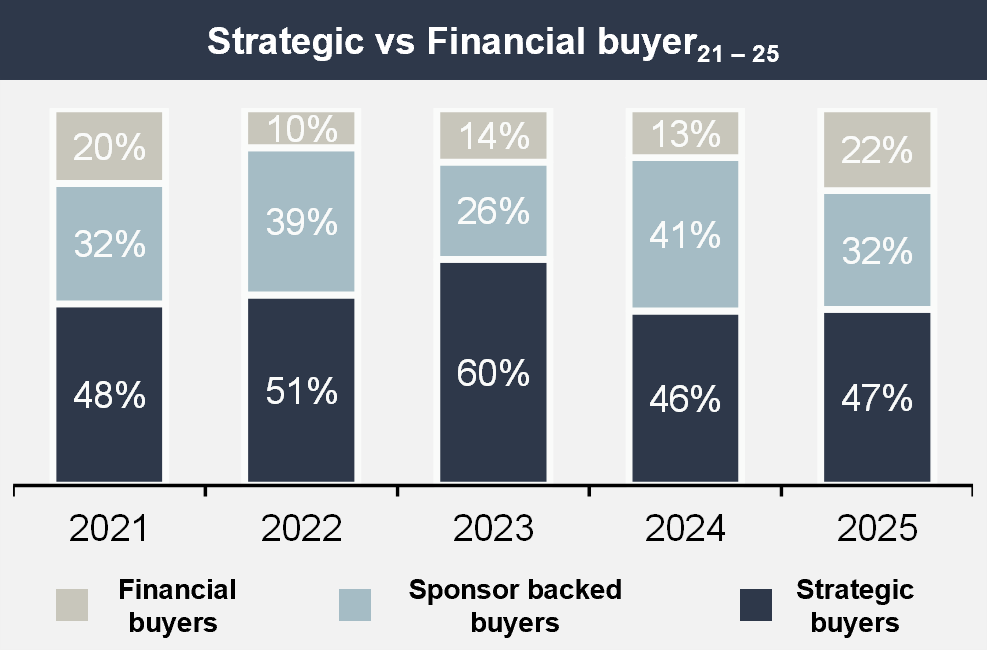
No single buyer type controls this market anymore
In 2023, strategic buyers without PE backing made up 60% of deals. One type of buyer dominated, and owners had one obvious kind of conversation to have when they wanted to sell.
By 2025, that disappeared. Financial buyers reached 22%, their highest share in five years, and sponsor-backed platforms held 32%. Three buyer types, each active, each competing.
That’s the real shift: not just that PE is bigger, but that owners now have more than one credible path to a deal.
“Owners today have a wider set of potential buyers and deal structures to consider than they did two years ago. With our decades of sector experience and global network, we’re well placed to help owners navigate that complexity and find the right partner for their business, wherever in the world that buyer may be.”
– Bart Jonkman, Managing Partner, Investec Advisory
Why this matters even if you’re not selling
Active PE capital signals real deal appetite, not just interest, from full acquisitions to sponsor-backed partnerships built for consolidation. This is relevant if you’re:
- Weighing succession
- Considering a partial exit
- Simply want to understand how your business might be valued
Our market expertise put us in contact with the leading PE investors active in animal health, as well as strategic buyers. That gives us a clear view of the buyer landscape, and the right connections to it. The graph below shows a selection of relevant European PE firms for example.
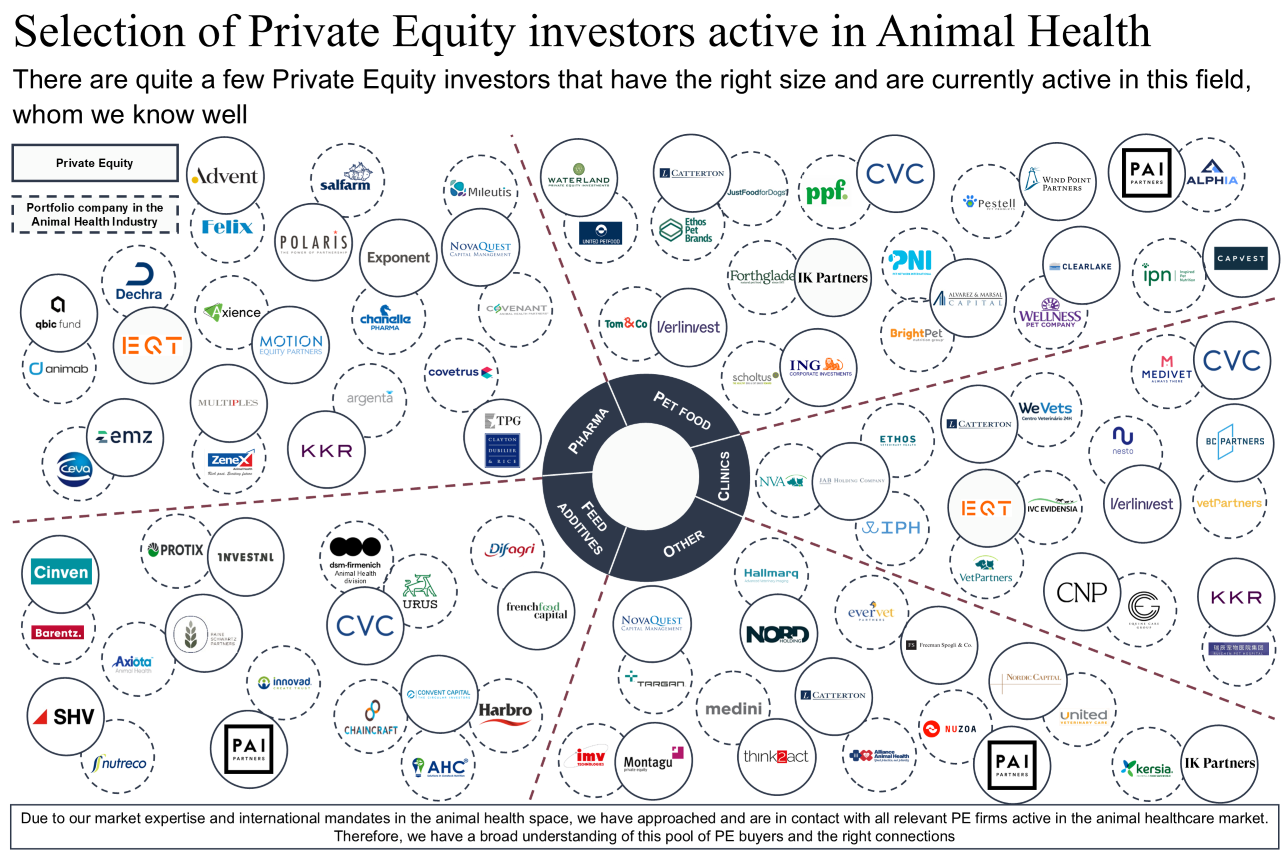
Case study: Finding VievePharm the right buyer
VievePharm was a small, family-owned animal health company in rural Netherlands, built around a specialism in bolus technology. When its founder explored a sale and succession, he trusted Investec Advisory to lead the process.
At 15 employees, VievePharm was the kind of business most buyers overlook. We didn’t. Two decades in animal health showed us what the headcount didn’t: a leading bolus technology range, export relationships across 25+ markets, and real platform potential. We took the opportunity to nine countries globally.
The response exceeded expectations. 10 parties, from listed corporates to private equity houses, competed for the business. We guided the founder to the best outcome.
The buyer was Zenex Animal Health, one of India’s largest animal health companies, backed by Multiples Equity. They saw VievePharm as its new European base. Investec closed the deal on excellent terms for the founder and his family, well ahead of what a domestic-only search would likely have achieved.
Rather than being absorbed product line, VievePharm now operates as Zenex’s European platform, with production and jobs retained locally.
About Investec Advisory
For over two decades, we’ve advised founders, companies and private equity firms on their M&A transactions. Our animal health expertise runs deep, and our reach is global.
Want to talk through what this means for your business?
Contact Bart Jonkman and Thom Deckers
Navigating Liquidity in a Slower Private Equity Exit Market
Private equity firms across Europe are operating in a more complex and constrained environment. M&A activity has pulled back from its 2021 highs, exit timelines have lengthened, and distributions to LPs remain well below historical norms. Against that backdrop, GPs are being asked to do more with fewer readily available options and to think much more deliberately about how liquidity is generated and delivered across the fund lifecycle.
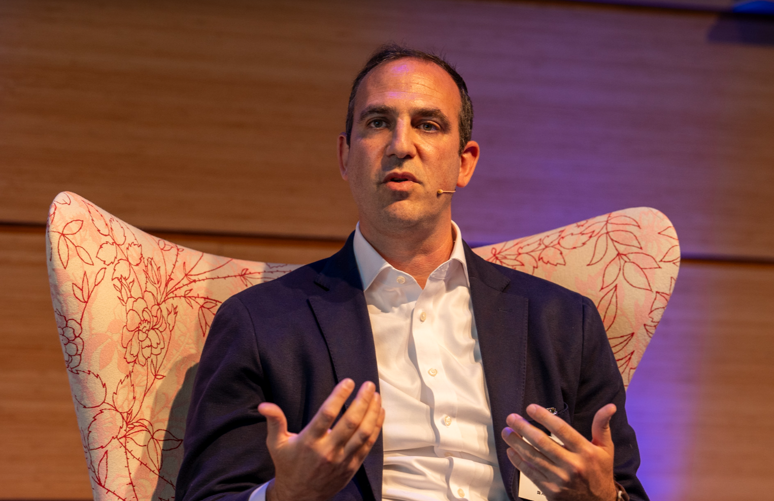
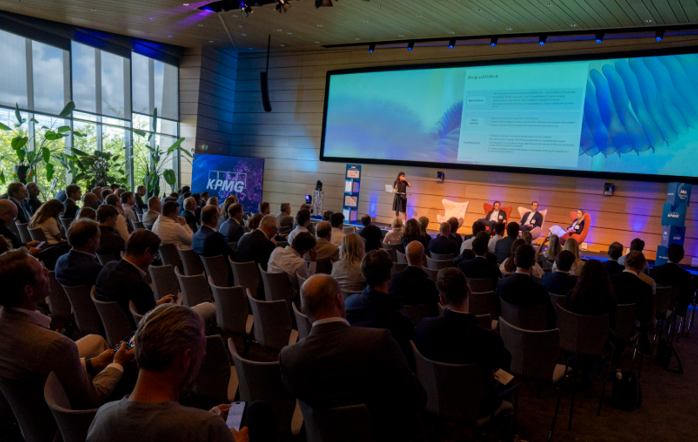
Those themes shaped the discussion at the M&A Community Netherlands Private Equity Summit 2026, held on Tuesday 9 June in Amstelveen, where Investec hosted a breakout panel examining how GPs are adapting to a market where traditional exit routes are less accessible, and liquidity management has become a strategic priority.
A market under pressure
Robert Bosch opened by setting out the forces behind the current slowdown, noting the continued macro uncertainty, higher-for-longer interest rates, entrenched bid-ask spread, volatile IPO market, risk averse stance of strategic buyers and AI disruption.
The data makes the trend clear. Private equity exit value increased by approximately 40% in 2025, but exit volumes fell by around 15%, reflecting concentration in larger assets while the mid-market remained subdued as opposed to prior years. Average holding periods have stretched to approximately 6.6 years (50%+ of companies in portfolio 4 years or longer), bid-ask spreads remain relatively wide, and with strategic buyers becoming more selective and the number of IPOs in 2025 still below the long-term average, viable exit routes have narrowed considerably.
Audience polling added an important nuance. When asked what the biggest constraint on their business is today, 40% of attendees cited geopolitical and macroeconomic uncertainty – ahead of slow exit markets at 24% and lack of quality assets at 20%. Debt cost barely registered at 4%. The result suggests the exit slowdown is less a structural problem with the M&A market than a symptom of a broader confidence deficit – one that time, more than financial engineering, will ultimately resolve.
Financing conditions: more refinancing, less new money
Alexandre Neiss noted that the financing market reflects this dynamic closely. With macro uncertainty dampening new deal activity rather than debt availability itself, the debt markets have remained open, but GPs are using them differently.
Debt issuance in the European mid-market has remained resilient, but its composition has shifted materially. New deal financings account for only approximately one third of total flow, with refinancings and add-ons making up the balance. Private credit continues to gain share from banks with 70%+ of mid-market deals financed by Private Credit lenders, with boundaries between syndicated and direct lending markets blurring further especially in the Large Cap space. A supply and demand imbalance has driven spreads lower since 2022, and while conditions remain accommodating for strong credits, certain sectors – notably technology – are attracting pricing premiums.
In this environment, GPs are refocusing key lending relationships: the ability to support borrowers’ financing needs remains important, but a long-term partnership approach, structuring flexibility and lending experience across multiple cycles matter just as much.
Continuation vehicles: genuine solution or deferred problem?
One of the longer discussions centred on continuation vehicles. Currently approximately 14% of PE exits are completed via this route, with expectations that this could rise to around 30% within five years.
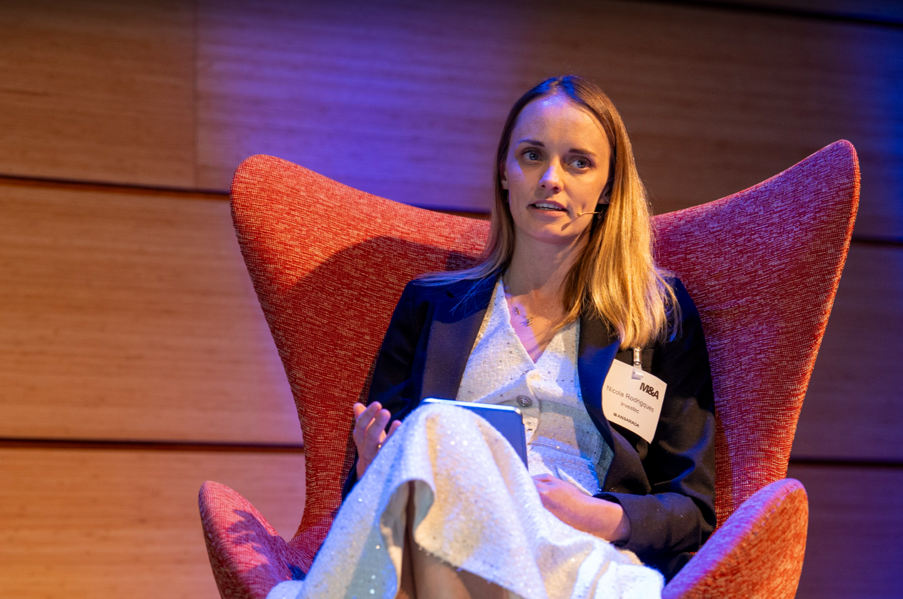
Nicola Rodrigues noted that continuation vehicles have evolved into a core liquidity solution within the broader GP toolkit, reflecting a more structural shift in how managers approach exit timing and portfolio management. Rather than a traditional exit, they allow GPs to restructure ownership and create optionality for LPs – providing liquidity to some investors while allowing others to retain exposure to high-conviction assets.
She highlighted that their effectiveness depends on strong governance, transparency and alignment, particularly around pricing and process, and that their value ultimately lies in supporting genuine value creation rather than simply extending hold periods.
Alexandre Neiss added that from a financing standpoint, GPs are sometimes looking at financing solutions above Borrower level like Holdco debt to create additional liquidity. The broad consensus was that continuation vehicles, NAV facilities and GP-led solutions are becoming structural parts of the toolkit rather than exceptional measures.
Audience polling nevertheless suggested that, in practice, full exits still remain the default preference for many participants. Even as continuation vehicles become more established, their use remains selective rather than universal. The risk is misuse – deploying these instruments to defer difficult marking or exit decisions rather than to manage liquidity with genuine conviction.
Fundraising dynamics and the LP perspective
That exit pressure flows directly into the fundraising environment. While there remains significant value sitting in portfolios, it is not being realised and returned to LPs at the pace the model relies on. Global buyout distributions as a percentage of net asset value have fallen to approximately 14%, against a historical norm of 20–30%, constraining LP liquidity and their ability to recycle capital and slowing fundraising momentum, particularly in the mid-market.
Nicola Rodrigues noted that this is not just creating fundraising pressure – it is also changing what LPs prioritise. With distributions still well below historical levels, DPI and realised track record have become much more important in manager selection, particularly where re-up decisions depend on a clear ability to generate and return capital. In response, GPs are increasingly turning to a broader and more flexible toolkit – including continuation vehicles, NAV financing, hybrid structures and GP-level financing solutions – to create optionality around hold periods and exit timing while supporting liquidity outcomes for LPs.
In that environment, the managers that stand out will be those with a clear, repeatable strategy for turning portfolio value into realised outcomes for investors. Firms that can combine disciplined value creation with flexible liquidity management and thoughtful exit execution will be best placed to outperform.
Outlook
Audience polling at the close of the session offered a final read on sentiment. When asked how their company is most likely to generate liquidity over the next 24 months, 70% pointed to corporate M&A. This is a signal that trade sales remain the preferred route even if current market conditions make them harder to execute. Continuation vehicles were cited by 13%, sponsor-to-sponsor sales and dividend recaps each at 7%, and IPOs at just 3%.
The discipline argument runs through each part of the recovery ahead. In the M&A market, it means being selective about timing and exit route. In financing, it means maintaining structuring discipline as competition intensifies, and placing greater emphasis on partner selection – particularly as the lender base becomes more diverse and capital behaves differently through the cycle.
Fund solutions are now firmly embedded in the private equity model, with continuation vehicles, NAV and related tools forming a broader, more flexible toolkit that GPs are using selectively and with discipline to navigate liquidity constraints and deliver outcomes for LPs.
The European private equity market remains fundamentally attractive, but the path to liquidity is more complex than it was. As traditional exit routes remain constrained and hold periods continue to extend, liquidity management has become a more important component of portfolio strategy rather than simply an outcome of successful exits.
Success in the next phase of the cycle is likely to depend on more than asset selection alone. GPs that can combine disciplined value creation, financing flexibility and thoughtful exit execution will be best positioned to navigate a slower market and outperform as conditions improve.
Event Gallery
Strengthening our Industrial Tech & Services team
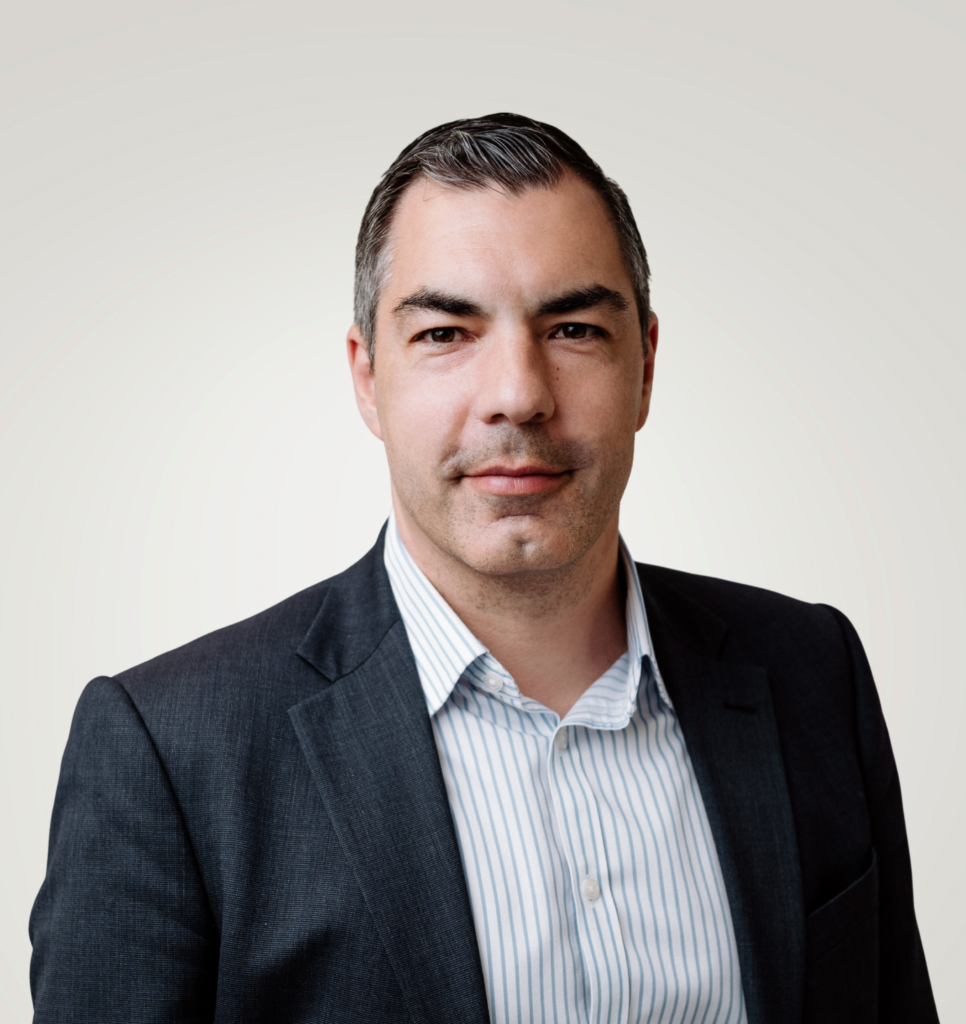
Investec is pleased to welcome Matthias Odrobina as Managing Director of our European Business Advisory and a senior member of the global sector team covering Europe, UK, Africa, the US and Asia with impartial advice on cross-border transactions.
Matthias brings deep sector expertise across industrial technology (particular focus on smart industries, B2B software and digital transformation).
He has 20 years of experience as a trusted partner to boards and owners on mergers, acquisitions, divestitures, financings, and buyouts, with a particular focus on the industrial sector, B2B software, and business services.
Contact: Matthias Odrobina
Michel Degryck, Managing Partner, has been recognised by MergerLinks by Datasite among the Top Investment Bankers in France!
A well-deserved recognition of his leadership and long-standing commitment to clients.
Behind every successful transaction lies trust, judgement and long-term relationships.
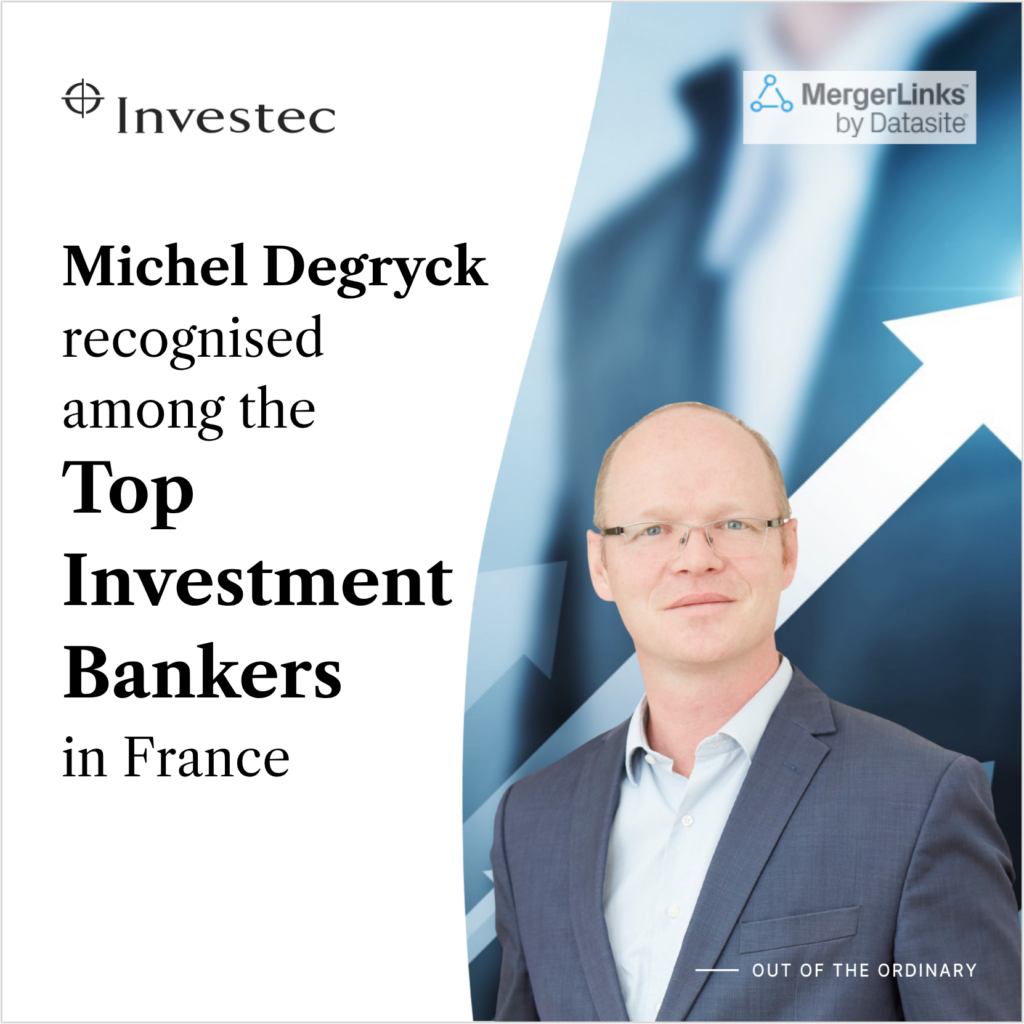
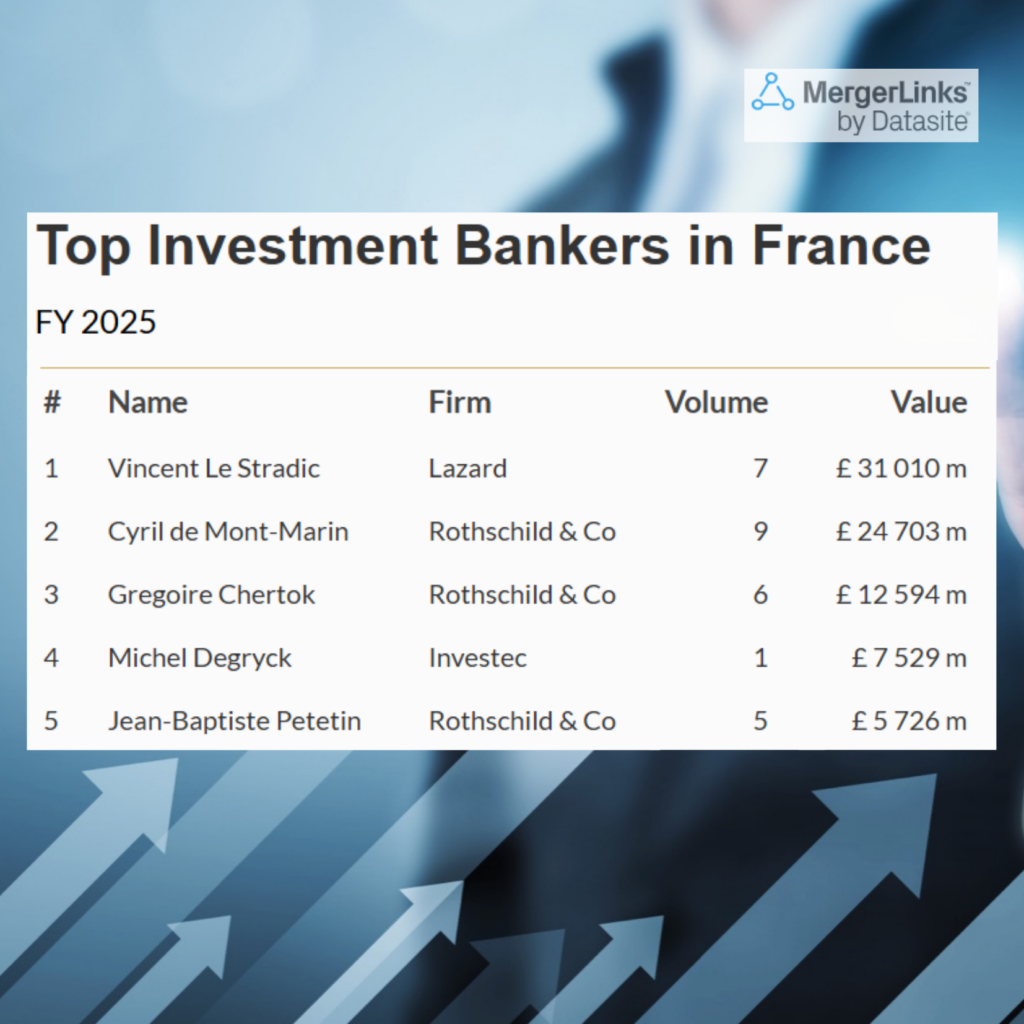
Explore the rankings: Top Investment Bankers in France FY 2025
We’re excited to welcome Jens Rutten as Partner in our Zurich office.
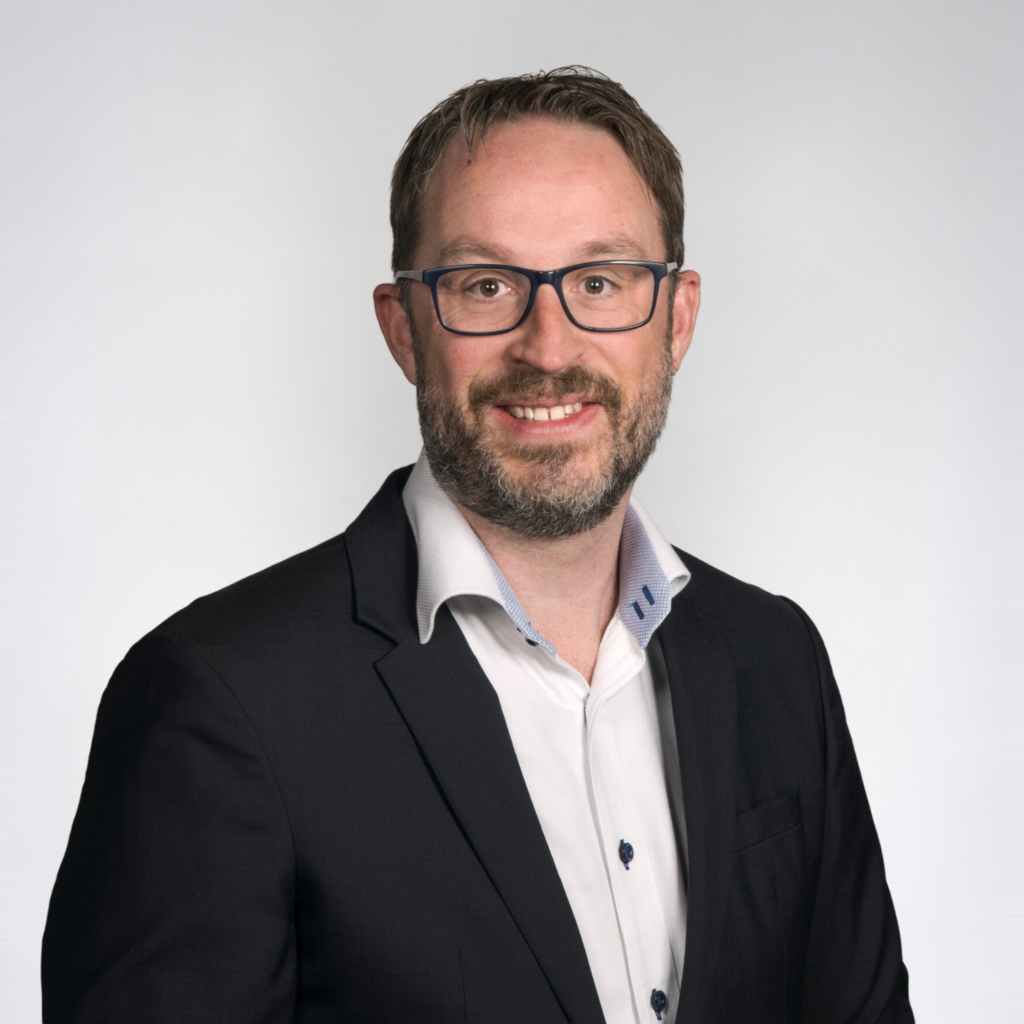
Jens joins from Oaklins, bringing extensive expertise in successions and corporate divestments, with the majority being cross-border deals. He has an outstanding track record in the Industrials, Food & Beverage and Consumer sectors.
His appointment reinforces Investec’s commitment to strengthening its Swiss mid-market team, combining local presence with our global platform of 300+ M&A professionals worldwide.
Contact: Jens Rutten
We’re pleased to announce a further expansion of our international M&A advisory business with the integration of Capitalmind Switzerland into the Investec brand.
The Swiss team, lead by Markus Decker and Thomas Ellenberger, is proud to join Investec, reinforcing our shared commitment to delivering tailored M&A advice and solutions.
It’s an important milestone for our team and clients, strengthening our presence and capabilities across Europe.
This latest acquisition underscores our commitment to expanding our advisory business, where we now have 300 M&A professionals based across 17 offices globally, and complements the growth of Investec’s integrated offering in Switzerland, which includes private banking, wealth management and direct lending.
“By uniting our M&A professionals accross Europe, we are able to bring fresh ideas and tailored solutions to clients in Switzerland and internationally.”
– Markus Decker, Managing Partner of Swiss office
“This acquisition deepens our Swiss presence and enhances global collaboration, connecting clients to international and local investment opportunities.”
– Jonathan Arrowsmith, Head of Investment Banking, Investec
All our Swiss team members:
Markus Decker, Thomas Ellenberger, Yanik Costa, Dr. Miró Feller, Tim Graber, Kai Kiesinger, Lorenzo Mattei, Luca Stalder and Gabi Korolnyk
Learn more:
Switzerland | Investec Advisory
Investec is proud to have been the official sponsor of HC & FC Victoria, a Dutch football club, during their remarkable, title-winning 2024/25 season.
Founded in 1893, HC & FC Victoria is one of the oldest football clubs in the Netherlands. To support the club’s talented homegrown players from Amsterdam and Utrecht, Investec provided electric cars, making it easier for them to attend training sessions and matches. This initiative has played a key role in retaining Victoria’s promising local talent and building a strong foundation for the club’s future.
Following a thrilling 2-1 victory, “The Good Old” Victoria clinched the championship and, for the first time, will compete at the national level in the fourth division next season.

Promotion to national league
With just five matches remaining, the team was in third place, but last week they claimed the top spot for the first time this season. In a dramatic finale on the last day of the league, the Hilversummers secured a decisive victory, outpacing their rivals SDC Putten and WV-HEDW in the title race.

“This championship means the world to me and the club. We’re all unpaid players, simply enjoying football with friends, and yet we managed to achieve this. Our motivation comes from within, and I’ve never seen a Victoria team as good as this one. We truly are a team in every sense. The feeling is indescribable – I know I’ll cherish this for the rest of my life.”
Captain, Rik Langhout
Investec M&A advisory recently facilitated the negotiation module again for the NVP Essentials Course in the Netherlands.
This highly regarded multi-day program, organized by the Dutch Private Equity & Venture Capital Association (NVP), provides a comprehensive overview of the complete private equity investment process, equipping starting PE and M&A professionals with essential knowledge and practical skills.
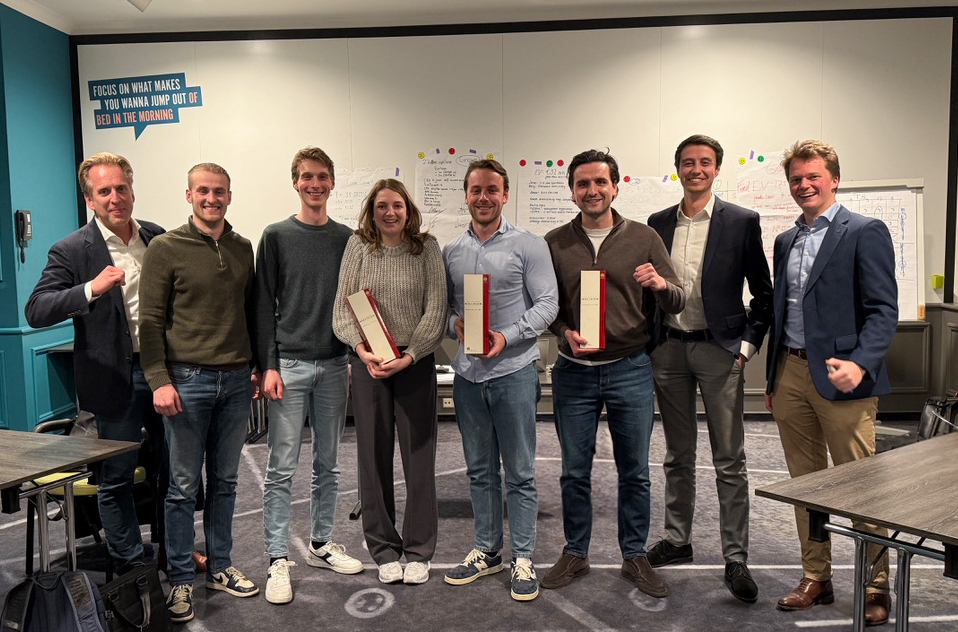
During the PE Essentials training, the professionals went through the entire PE investment process. Investec led the workshop focused on negotiation strategies, while other speakers covered topics such as bank financing, investment management, due diligence and exits.
Our negotiation workshop equipped participants with practical tools and strategies for maximizing deal outcomes. This hands-on training directly enhances their daily work performance. Following a challenging round of negotiations in our case study, champagne was awarded to the buyers and sellers who achieved the most favorable outcome at the end.
Investec’s continuous involvement in the NVP Essentials Course underscores our commitment to continuous professional development and dedication to staying at the forefront of the private equity industry.
Investec announces the appointment of Michael Eriksen as Head of Nordic M&A in support of its strategy to significantly grow its presence in Europe. Michael brings over 25 years’ experience as an M&A advisor to companies in the Nordics.
In his new role, Michael will focus on identifying and pursuing growth opportunities for clients, in line with Investec’s 25-year track record as a trusted M&A advisor to clients globally, particularly in Europe. Investec provides tailored M&A advice to clients, many of whom operate in the mid-market across a wide range of sectors, helping them achieve their growth objectives.
In 2023 Investec acquired a majority interest in Capitalmind and, with effect from today, completes its transition to the Investec brand.
“Companies across multiple sectors in the Nordics are actively seeking opportunities to expand beyond their borders. Michael’s established relationships and expertise will be invaluable as we enhance our M&A advisory capabilities in the region. At the same time, we are committed to bringing our broader expertise to the Nordics, including leveraged finance and fund solutions for private equity, such as GP financing, continuation funds, and NAV facilities.”
Jan Willem, Managing Partner and Board Director of Investec Continental European Advisory BV (ICEA)
“The Nordic region is a dynamic and expanding market. I firmly believe that Investec, with its strong client focus and comprehensive banking capabilities, is ideally positioned to capitalise on the opportunities that lie ahead.”
Michael Eriksen, Head of Nordic M&A
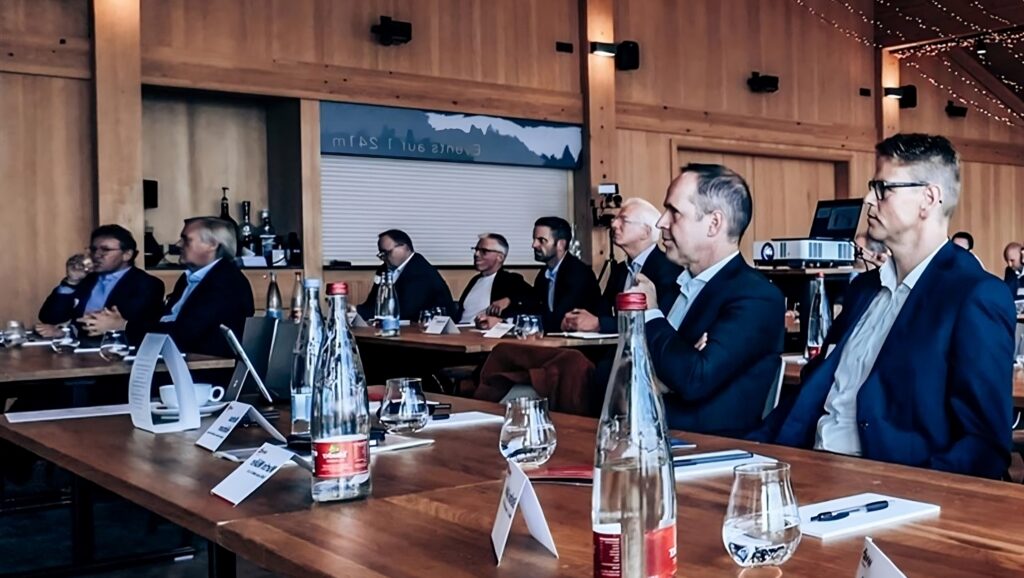
Recap | Information event: Financing summit | 11 October 2024 | Bergwelt Kandel
Creative solutions for challenging times
The economy is faltering, and order intake has become volatile or even shrinking. Companies planning a refinancing, a generational change or having to fund investment programs are facing difficult market conditions. The buzzword ‘transformation’ is being used inflationary, and some even speak of de-industrialization in Germany. What role do banks and financial partners play in this situation? Does debt capital still make sense, or do mezzanine financings and minority equity offer a real alternative?
These and other questions were the focus of the wvib Financing Summit on the Kandel, where expert insights were provided by Michael Fabich, Chairman Investec, and Thorsten Gladiator, Managing Partner Investec. They discussed the crucial role and significance of the sector in today’s financial landscape.
The wvib (Wirtschaftsverband Industrieller Unternehmen Baden e. V. in the Southwest of Germany) is a trade association for industrial SMEs, a mouthpiece and service provider for family-owned medium-sized companies. Founded in 1946 by entrepreneurs for entrepreneurs, wvib comprises 1,040 manufacturing companies with 384,000 employees and a worldwide turnover of 75 billion euros. The association has over 60 full-time employees. At the invitation of wvib, Investec took part in the wvib Financing Summit with a presentation together with representatives of financing providers and companies.
Private equity as a flexible financing instrument: from locust to grasshopper
Private equity (PE) has undergone a remarkable transformation in recent decades. Once decried as ‘locusts’, private equity has now developed into an instrument to fund sustainable growth. PE also plays an important role in German medium-sized companies when it comes to successfully managing succession arrangements, changes in ownership or strengthening of equity. The success of the model is reflected in the figures: In Germany today, there are over 470 private equity firms that have invested in more than 5,500 portfolio companies, which together generate annual sales of €293 billion and employ around 1.5 million people. In the last five years alone, around €76 billion has been invested in the market. Thorsten Gladiator and Michael Fabich emphasize that PE today is more than just financial engineering. The focus is on long-term value enhancement through targeted operational improvements and strategic growth.
Between transformation and regulatory pressure
What will 2024 look like for a German automotive supplier? The Leiber Group, a family-run company with a long tradition, invested heavily in e-mobility – once a reason for customers and financing partners to be pleased. However, the expected unit numbers fell short of the forecasts by up to 80%. Managing Director Martin Müller describes the situation as a ‘vicious cycle’: price pressure from customers, constant transformation pressure and a growing flood of regulation are weighing on both the workforce and the company’s liquidity. Nevertheless, Leiber is looking optimistically to the future with a new brand identity and the motto ‘with ease ahead’. A consortium of five savings banks is securing the financing. ‘We don’t complain, we act’ – a motto that fits perfectly with the current times.
Financing the future – how, who and when?
A “management buyout” instead of a handover within the family raises exciting questions: How much capital can the management raise? How do you organise a gradual transition? The mechanical engineering firm MAFAC, managed by Rainer and Joachim Schwarz, tackled this process at an early stage. For the new managing director and shareholder Stefan Schal, financial security through a complex construct of silent partnerships, fixed-interest loans and a guarantee was anything but a given. The solution preserved the values of the family business and secured its future.
Global markets, local solutions
The Sparkasse Freiburg-Nördlicher Breisgau also sees the world as changing. While sales markets are global, financing is often secured locally. This is where Markus Hildmann comes in. With topics such as sustainability regulation, corporate finance and corporate succession, the Sparkasse supports companies with modern software solutions such as Nawisio, which are designed to facilitate compliance with CSRD, EU taxonomy and CSDDD. The centre of excellence for corporate succession is designed to ensure that the 125,000 companies affected each year find a suitable solution. Hildmann emphasises that it is crucial to involve financing partners at an early stage.
Mezzanine financing: stopgap or strategic advantage?
Mittelständische Beteiligungsgesellschaft (MBG) and Bürgschaftsbank BW work closely together. For Chris Hammer, the silent participation is a strategic tool for getting back on the offensive from a defensive position. Thanks to its subordination, lack of exit pressure and non-interference in day-to-day business, this instrument can create a solid basis for further outside capital without the need to sell company shares. Creditworthiness and room for maneuver are maintained – ideal for transformations, growth financing, innovations, successions or start-ups.
Conclusion
According to a study by the German Economic Institute (IW), Germany will need around €1.3 trillion of financing between now and 2030 to achieve the transformation and future growth it needs. This staggering figure makes it clear that traditional financing methods alone will not be enough. To successfully shape the economic future of German SMEs and finance transformations, it will take courage, collaboration and an open mind when it comes to tapping new sources of capital.
Watch the recap of the Summit here: