Close

Investec Rhino Lifeline

Celebrating ten years of creating powerful partnerships to preserve our natural heritage. Ten years ago, we established Investec Rhino Lifeline to respond to the rhino crisis. Today, we know that at the heart of conservation and a healthy, biodiverse environment, are the people who live within it. There is strength in numbers, and with our incredible partners and the communities living alongside reserves, we will work together to save our rhino and natural heritage, so that we may continue, sustainably into the future.

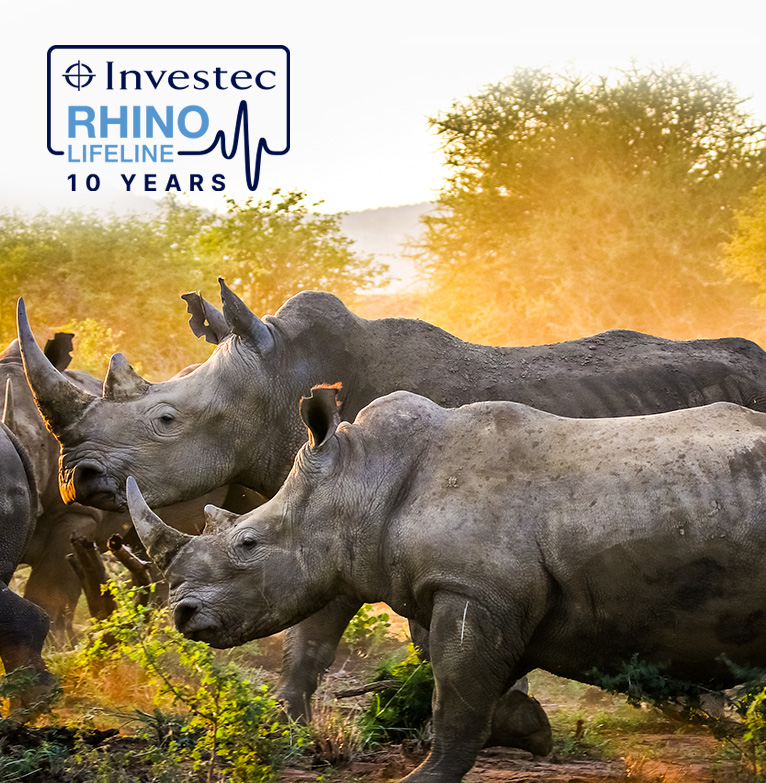
white rhino on grasslands

The impact of Investec Rhino Lifeline since 2012

130 rhino rescued, from which 8 calves have been born, and 46 released back into the wild
Every rhino counts. When rhino mothers are poached, young calves are left orphaned, injured, and at risk from predator attack. We support rhino rescue by partnering with experts who can rehabilitate and eventually release them into well-protected areas of the wild. "You do not give up on them, ever." Petronel Niewoudt, Care for Wild.
53,600 children benefit from conservation and education enrichment programmes 
Through partnerships to bolster rural education with Coaching Conservation, GWF and the SA Wildlife College.  “Investec has walked a long journey with GWF and we are so proud of what we've achieved together, to make the most amazing impact in young people's lives.”  Kate Groch, Good Work Foundation
Advice on over 150 wind and solar renewable energy projects from Birdlife SA 
We try to understand our business impact on biodiversity, such as our ten-year relationship with Birdlife SA, where we worked closely with them to manage and mitigate the impact of renewable energy projects on birdlife, particularly birds of prey. 
830 internships through YES and our conservation partners 
Since the inception of the Youth Employment Service in 2018, Investec has supported internships with our conservation partners, Sabi Sands Pfunanani Trust, Care for Wild and GWF. 
984 rangers trained to respond to vulture & other wildlife poisoning incidents 
“The value of vultures as scavengers is essential to a healthy ecosystem. If we lose vultures we lose a vital, natural sanitary service that could lead to increased spread of diseases affecting both animals and people.” Andre Botha, EWT.

Episode 2: Conservation, communities and the rhino crisis

Listen now

The crux of the matter is that when your physiological needs are not being met, there is no incentive to conserve anything, let alone a rhino. Care for Wild, the largest rhino sanctuary in the world understands this and has from its start over 11 years ago put communities at the centre of its conservation model. We hear from the founders and some of their employees. Read more.


More than just rhino

conservationists harvesting spinach
...we must work together towards a cleaner, more resilient and inclusive world

Ten years ago, when rhinos were being decimated, Investec acted to help save this magnificent species before it was too late.

Since then, we have supported the rescue and rehabilitation of over 130  rhinos, from which at least eight calves have been born, raised awareness with millions of people internationally, reached over 53 000 children in South Africa with conservation learning, and provided conservation learnerships to over 830 young people through the Youth Employment Service (YES). 

Investec’s conservation strategy reflects the group’s focus on climate action and inequality, by protecting critically endangered species and the environment they inhabit. Through our projects we aim to have a positive impact on our natural heritage, by uplifting vulnerable communities living alongside national parks and reserves, promoting a clean environment through carbon-reducing initiatives, and combatting illegal wildlife trafficking, using our business systems and resources.  

We believe that investing in biodiversity and inclusive conservation is vital to sustaining our rich wildlife and will lead to a better future for us all. 

Episode 4: Reimaging education in rural SA

Listen now

For decades, rural children in South Africa have suffered a debilitating condition: an estrangement from learning that causes a lifetime of struggle. One NPO, Good Work Foundation, is providing an antidote.  Hear from GWF's founder, teachers and those who have gone through GWF programmes and are now gainfully employed. Read more.

Vultures are vital to our ecosystems

Lappet-faced vulture head and shoulders
...and we must protect the alarming population decline

Investec Rhino Lifeline recognises the critical role that vultures and other birds of prey play in our ecosystems. That's why we're proud to partner with the Hawk Conservancy Trust (HCT) and the Endangered Wildlife Trust (EWT) to help preserve these critically endangered and highly threatened species. 

EWT and Hawk Conservancy Trust parter with a range of NPOs through Vultures for Africa. In the past year, they have trained 984 rangers in 51 poisoning response workshops in seven countries in southern and east Africa. At the same time, they tagged over 80 vultures for monitoring and more rapid detection of wildlife poisoning incidents. 

Over 60% of vulture deaths are due to poisoning although they are vulnerable to many other factors. Vultures not only prevent the spread of disease, they also, according to a recent article, prevent huge amounts of carbon emissions. 

In the UK, through our partnership with Hawk Conservancy, we also support the rehabilitation of birds of prey and their release back into the wild, as well as a conservation education project to protect these apex predators. Last year they rehabilitated and released 34 birds of prey back into their natural habitat.

Fighting for the future of the African Wild Dog

EWT Wild Dogs with collars
...and seeing EWT help the growth of the population in Kruger by 122% in ten years

Investec has supported wild dog through EWT's Carnivore Conservation programme since 2012.  

In that time, the work of the EWT team in preserving, protecting, rescuing and community interventions has seen wild dogs in Kruger National Park grow from 180 dogs to over 400 dogs in 40 packs - a remarkable impact! This accounts for almost all the growth in the SA wild dog population in these ten years. 

One of the most endangered species, wild dog are vulnerable to human-wildlife conflict and tend to get caught in snares set to protect livestock, are shot by farmers who don't want them preying on their livestock,  or poisoned by scavenging on carcasses designed to distract law enforcement and other predators from poaching sites. 

Renewable energy: reducing the impact on birds and their habitat

Wind turbines with birds in field
...in partnership with Birdlife SA since 2012

Investec's power and infrastructure finance team has supported BirdLife South Africa since 2012. As a business, our aim is to understand and mitigate the negative impact that renewable energy projects can have on birds and their habitat. Renewable energy, both wind and solar, is an essential and necessary part of our response to climate change, but can have unintended negative impact. 

In the past ten years, Birdlife SA have advised on over 150 wind and solar energy projects over the last ten years, and their guidelines have been used in almost every renewable project in South Africa. 

Renewable energy infrastructure, such as wind turbines and powerlines, injures and kills birds, but can also result in the loss and degradation of natural habitats. Birds of prey are particulaly susceptible, and in South Africa a quarter of these are already threatened with extinction.  As apex predators, the knock-on effect to biodiversity and ecosystems is much larger than simply losing a few birds or bird species.

Birds of prey are indicator species, or “ecological barometers”, extremely sensitive to environmental changes in an ecosystem, so monitoring changes to their populations give us insight into environmental threats such as climate change, habitat loss and wildlife trade and chemical and pollutant levels, or other airborne threats. 

Select your preferred cause to view the donation information

Funds assist injured or orphaned rhino, or pangolin rescued from illegal wildlife trade

Pangolin with Johannesburg Wildlife Vets

Donate to rescued pangolin


Investec Rhino Lifeline supports Johannesburg Wildlife Veterinary Hospital's first dedicated pangolin ward.

To support their pangolin rescue and rehabilitation:

EFT:  Johannesburg Wildlife NPC, First National Bank, Acc 62658 400 264, Sort code 255355, Ref INVESTEC PANGOLIN

Joburg Wildlife Vet logo

Browse ten years of highlights

Feb 2021: First dedicated pangolin ward in Africa

JWVH opens hospital ward dedicated to pangolin rescued from the illegal wildlife trade


While illegal wildlife trade is a global crisis, South Africa has become a global hotspot for poaching and trafficking syndicates due to the country's biodiversity and abundant wildlife. Pangolins are currently the world's most trafficked non-human mammal. 

On World Pangolin Day, 20 February 2021, Investec announced our new partnership with the Johannesburg Wildlife Veterinary Hospital (JWVH) to create and support the first dedicated pangolin veterinary ward in Africa. Since then, JWVH has rescued 42 pangolins, successfully releasing 19 back into the wild. Together with the African Pangolin Working Group (AWPG), the JWVH oversees the release and post-release monitoring of all pangolin discharged from the hospital.

JWVH is currently the only facility mandated by the South African government to treat and rehabilitate pangolins confiscated in South Africa by the SAPS and conservation law enforcement officers on a long-term basis. 


Learn more about JWVH and the plight of the pangolin

Learn more about our work with rhino

Leave your email address or phone number and we'll get in touch

First Name *

This information is required

Minimum characters 2

Surname *

This information is required

Minimum characters 2

Number *

This information is required

Minimum characters 2

Please enter digits only.

Comment

This information is required

Minimum characters 1

0/500 characters

Thank you for contacting us, we will get back to you shortly.

Sorry there seems to be a technical issue

Sending...